In modern India, the archetype of the daughter-in-law has undergone a profound evolution. Today’s woman is educated, financially independent, and unapologetic about her individuality. Yet, despite this progress, a subtle, age-old domestic double standard lingers within many households. When a woman asserts her boundaries, voice, or ambition, traditional structures struggle to assimilate her power. Instead of accepting her strength as a positive force, societal conditioning often defaults to vilifying her—framing an outspoken, self-assured woman as a disruptive threat to household harmony.
It is precisely this friction between modern female agency and traditional prejudice that forms the soul of Balaji Mohan’s horror-comedy fantasy Nayyi Navelli, produced by Aanand L. Rai’s Colour Yellow Productions. At the center of the film is a punchy, defining dialogue delivered by Yami Gautam:
“Bete mein khot dekhna mushkil hota hai, aur bahu mein daayan dekhna aasaan.”
(It’s hard to see flaws in a son, but easy to see a witch in a daughter-in-law.)
This single line pierces straight through traditional domestic dynamics, turning a festive genre entertainer into a resonant commentary on female demonization and societal hypocrisy.
Yami Gautam has consistently chosen roles that demand conviction, gravitas, and nuanced storytelling. Following her recent acclaim in HAQ, where she delivered a powerful performance portraying the emotional resilience, quiet dignity, and identity struggle of a Muslim woman navigating legal and socio-cultural battles, Nayyi Navelli sees her stepping into another transformative role.
In Nayyi Navelli, Yami stands firmly as the sole hero and anchor of the narrative. She handles the delicate blend of situational comedy, supernatural mystery, and emotional weight with effortless grace, proving once again her ability to carry a film entirely on her shoulders.
Synopsis
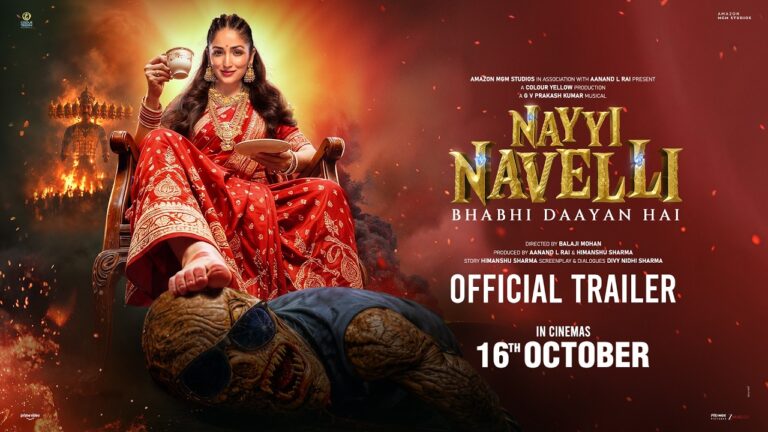
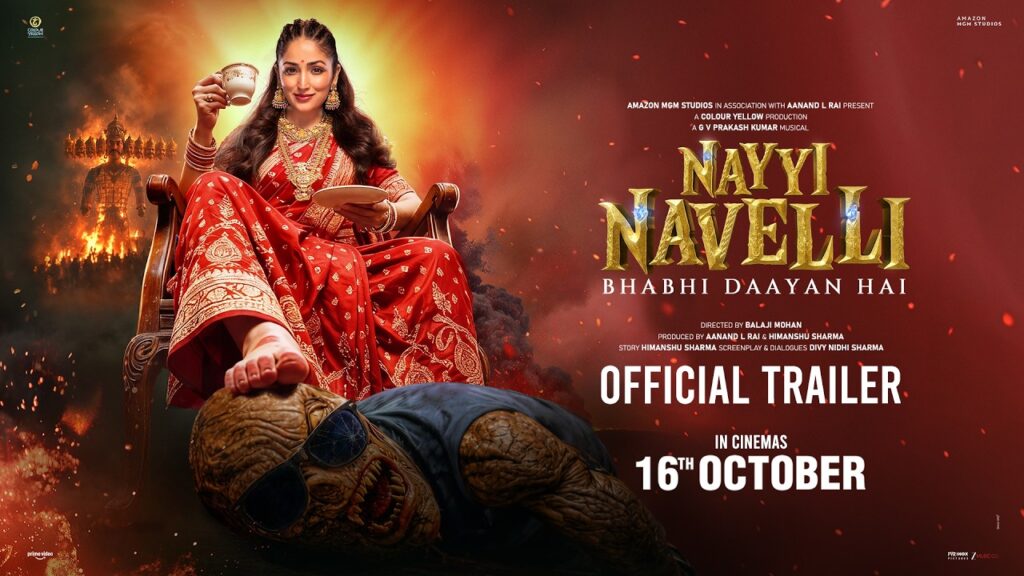
Set against the bustling, vibrant backdrop of Meerut during the festive season of Dussehra, Nayyi Navelli follows a tight-knit family preparing for celebrations when mysterious supernatural occurrences begin to unfold following the arrival of their newly wedded daughter-in-law, Mohini (Yami Gautam). As bizarre incidents escalate, suspicion quickly falls upon her, turning the household upside down as they try to decipher whether they are dealing with an innocent bride or an ancient supernatural force.
1. The ‘Bahu vs. Daayan’ Metaphor & Indian Family Values
What elevates Nayyi Navelli above standard genre films is how it handles its central theme without losing respect for the Indian family system. Indian households have historically prided themselves on unity—sticking together through thick and thin, weathering storms as a collective unit, and placing deep value on relationships.
The film captures this warmth, but cleverly uses the horror-comedy lens to expose a flaw: how quickly that very family unit can scapegoat a nayi naveli bahu when something goes awry. While male shortcomings are frequently cushioned, rationalized, or overlooked, an unfamiliar woman entering the home is scrutinized under a microscope. The narrative exaggerates this real-world bias, turning the subtle labeling of a strong woman into literally branding her a daayan. Yet, as the story unfolds, it reminds viewers that true family strength comes from trust, open-mindedness, and standing by one another rather than letting prejudice fracture relationships.
2. Mythological Lineage: Dharma vs. Adharma
Framed around Dussehra, the film ties its narrative to Indian folklore and Ramayana-inspired imagery, subtly weaving in an ancestral mythic connection to the eternal battle between Rama and Ravana. Beyond the laugh-out-loud moments, atmospheric jump scares, and festive visuals, the film operates as an allegory for Dharma (righteousness) versus Adharma (deceit and malevolence). It reinforces that genuine spiritual faith and moral integrity will always expose and overcome disguised evil.
3. Female Agency as the Protector
Rather than relying on conventional tropes where a heroine awaits rescue, Yami Gautam’s character redefines heroism within the domestic space. Mohini balances warmth and familial respect with formidable inner strength. She demonstrates that female power—when driven by righteousness and protective instincts—is not a threat to be feared, but the very shield capable of safeguarding the home and restoring balance.
At its core, Nayyi Navelli uses a quirky household setup and supernatural flair as a meaningful metaphor: it challenges society’s quickness to judge and vilify women, honors the enduring core of family togetherness, and leverages rooted mythological storytelling to remind us that light and righteousness will always prevail over darkness.
The film is well-supported by a talented cast including Addinath M. Kothare, Sunita Rajwar, Mita Vashisht, Sushmita Mukherjee, Aaditya Kulshreshth, Sonal Jha, Rajesh Dubeay, Prateek Pachauri, and Anurag Thakur. The film also marks the Hindi directorial debut of Balaji Mohan, backed by producers Aanand L. Rai and Himanshu Sharma under Colour Yellow Productions in association with Amazon MGM Studios. The narrative is built on a story by Himanshu Sharma, with screenplay and dialogues penned by Divy Nidhi Sharma. On the technical front, the film features cinematography by Rishi Punjabi, editing by Sumeet Kotian, and a festive, atmospheric musical score composed by G.V. Prakash Kumar.
Nayyi Navelli released nationwide in theaters today.
Get a glimpse of the festive horror-comedy in the official trailer below: