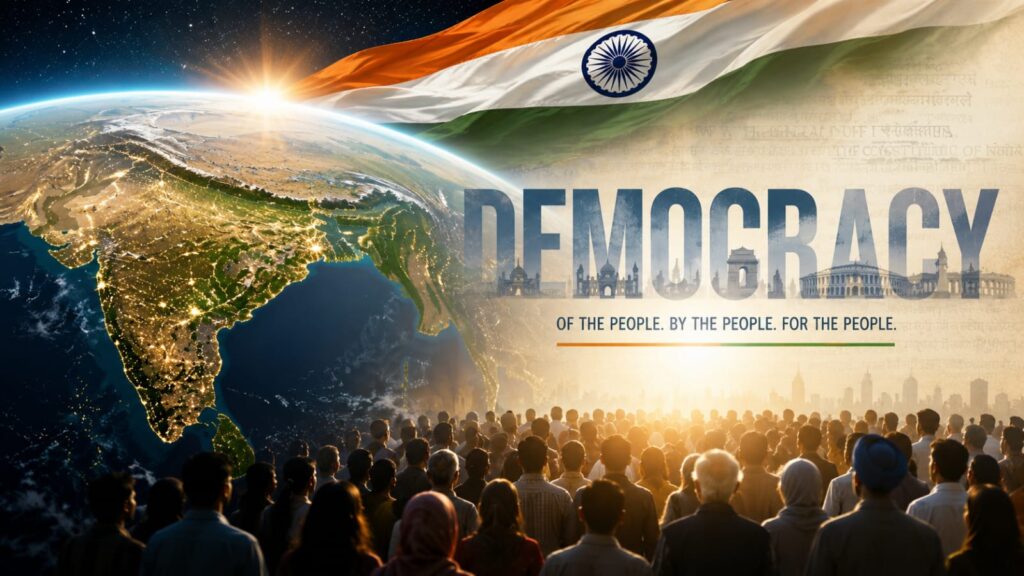
"In a country of 1.4 billion voices, the question is no longer who is speaking — but who is truly listening."
The Questions I Could No Longer Ignore
This morning, like many others, I woke up unsettled.
Not because I had answers, but because I found myself asking questions I could no longer scroll past.
I was sitting with my chai, phone in hand, watching the usual flood of forwards, hot takes, and breaking news. And somewhere between a forwarded video and a heated reply, I stopped. Not because the images were new — but because I finally saw what they were doing to us.
“The opposite of speaking is not listening. The opposite of speaking is waiting.” — Anonymous
What happens when young people across this country begin to feel unheard?
What happens when every conversation becomes a match to be won, and no one is left simply listening?
These aren’t questions for Delhi studios alone. They are questions you hear in the queues outside government offices, in the pauses between a farmer’s sentence and his sigh, in the silence of a mother who has stopped arguing with her son about his career choices because she knows he has stopped believing anyone is listening.
For over two decades, journalism took me into places where stories were unfolding long before they became headlines. A village in Bihar where the first question was never “what happened?” but “who will listen?” A textile worker in Surat who spoke for twenty minutes before I realised he wasn’t giving me quotes — he was finally speaking to someone who wasn’t rushing him.
The loudest voice in the room is rarely the wisest. And sometimes the most radical thing you can do is listen a little longer before deciding what you think.
So I’ve resisted the urge to rush to an opinion. Not because I don’t care.
Because I care enough to listen first.
The Noise We Live In
We are a country that loves to talk. Debate shows demand we pick a side before we understand the argument. Social media rewards the fastest reply, not the fairest one. Somewhere between the studio lights and the blue light of our screens, we have forgotten that the person on the other end is not an argument to be defeated — but a human being trying to be understood.
“Most people do not listen with the intent to understand; they listen with the intent to reply.” — Stephen R. Covey
But conversation was never meant to be a competition. Its purpose was never to win. It was to understand.
Every young person I have met — in coaching centres in Kota, in startup hubs in Bengaluru, in the waiting rooms of competitive exam halls — wants the same things: to study with purpose, to find work that dignifies them, to make their parents proud, to believe tomorrow offers something better than today.
These dreams aren’t political. They are profoundly human.
What the Silence Means
Perhaps every generation inherits the same quiet hope — to leave the world a little kinder, a little fairer than it found it. And perhaps every generation also inherits the same fear: that their voices may not matter as much as they wish they did.
That fear deserves our attention. Not because every demand is right. Not because every method is justified.
But because every society owes itself the responsibility of asking why its young people feel compelled to raise their voices in the first place.
“A riot is the language of the unheard.” — Martin Luther King Jr.
Listening is not agreement. . . Listening is respect.
And respect is the only thing that keeps a diverse society like ours from fraying at the edges.
What We Owe Each Other
We have become very good at preparing our replies while someone else is still speaking. We label before we understand. We defend our certainty before we become curious about someone else’s experience.
Perhaps the real crisis isn’t that we disagree.
It’s that we have forgotten how to listen without already preparing to respond.
“In the end, we will remember not the words of our enemies, but the silence of our friends.” — Martin Luther King Jr.
We often ask what our country owes us.
Maybe the better question is: what do we owe each other?
Patience? Empathy? The humility to admit that no single person, party, or ideology has all the answers?
Democracy Lives in the Small Spaces
Democracy isn’t lived only in Parliament or courtrooms.
It is lived in our homes. In our classrooms. Across dinner tables. Inside family WhatsApp groups where someone has muted the notifications because it’s easier than silence. In the way we speak to the person who sees the world differently.
And most of all — in the way we choose to listen.
“The ear of the leader must ring with the voices of the people.” — Woodrow Wilson
I don’t have all the answers tonight. I suspect none of us do. But maybe certainty isn’t what this moment is asking of us.
Maybe it is asking for something harder: a little more humility, a little more empathy, and the courage to stay in the conversation instead of walking away from it.
So before the next headline pulls us back in, here’s one question worth sitting with:
“When someone speaks… are you truly listening to understand, or merely waiting for your turn to respond?”
Because in a country of 1.4 billion voices, the answer to that might matter more than any headline ever could.
About the Author
Jeehan Bajaj is a 17-year-old Gen Z voice navigating the noise of modern India. Currently pursuing BAMMC at Mumbai’s Bhavan’s College, he splits his time between communication theory and creating — music and film production with his filmmaker father. When he’s not in class or on set, you’ll find him dreaming up sets of his own, inspired by the sounds of Hugel and Fred Again..*