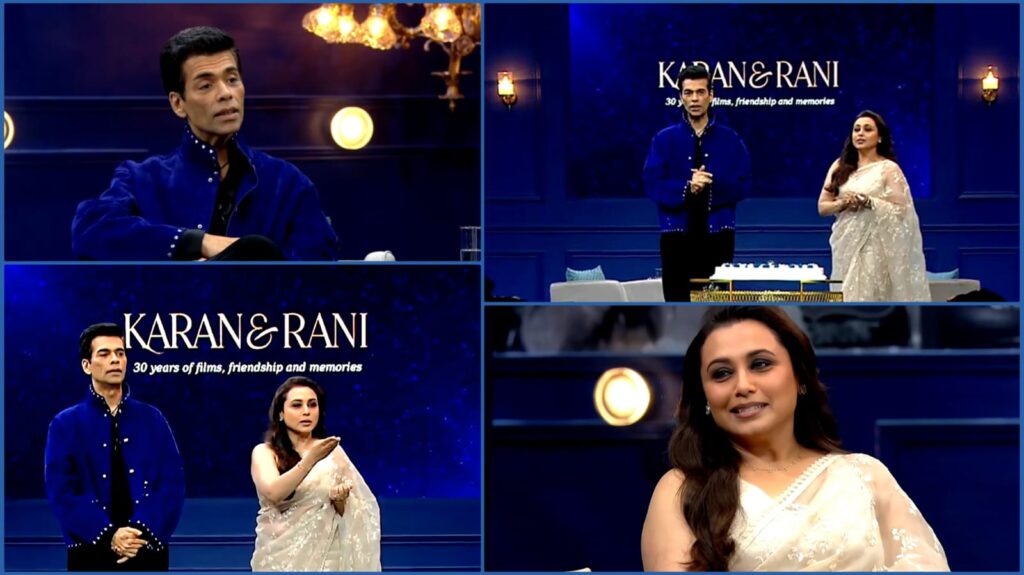
Some days stay with you long after they unfold—and our recent visit to Yash Raj Films Studios was one such unforgettable experience. Unfolding gently over the course of the afternoon, the gathering felt less like a formal event and more like time thoughtfully spent. Set against the legacy-rich walls of YRF, the day unfolded as an intimate, emotional, and deeply reflective conversation between filmmaker Karan Johar and one of Hindi cinema’s most enduring stars, Rani Mukerji, as she celebrated 30 iconic years in Indian cinema.
A Tête-à-Tête Rooted in Warmth and Honesty
Karan Johar opened the afternoon with a special, thoughtfully curated tête-à-tête, not just as a filmmaker or host, but as a close family friend—someone who has known Rani and her family beyond the arc of cinema. What followed was less an interview and more a heartfelt conversation—one that traced Rani Mukerji’s extraordinary journey from her humble beginnings to becoming an artist who today effortlessly wears multiple hats: actor, wife to Aditya Chopra—the quiet force and head honcho of YRF—and a deeply devoted mother to Adira.
Throughout the conversation, what stood out most was the easy, familial camaraderie between Karan and Rani—marked by deep respect not only for her craft, but for the person she is. Alongside that warmth, Rani’s steadfast commitment to her craft came through with striking clarity. She spoke candidly about her early days in the film industry, recalling how her debut film, Raja Ki Aayegi Baraat (1997), became a defining moment—shaping not just her career but also her instinct to choose roles that mattered. Roles that questioned patriarchy, portrayed women with agency, and refused to let society dictate norms.
The Director’s Actor, the Audience’s Artist
Listening to Rani speak, it became evident why she is often called the perfect director’s actor—disciplined, intuitive, and deeply invested. Yet, beyond that, she is an artist who has always placed her audience above everything else. From sharing moments where she spoke about literally muting parts of herself to fit a role, to laughing fondly about memories from sets past, the evening moved seamlessly between reflection and warmth.
Like millions of fans, choosing favourites from Rani Mukerji’s vast body of work feels almost impossible. Still, a few performances continue to leave a lasting impression: Kuch Kuch Hota Hai and Ghulam (1998), Saathiya (2002), Black (2005), Bunty Aur Babli (2005), the powerful Mardaani franchise (2014), Hichki (2018), and the deeply stirring Mrs Chatterjee vs Norway (2023)—a performance that earned her a National Award and reaffirmed her ability to connect with audiences across generations.
A Moment That Touched Every Heart
One of the most emotional highlights of the evening came when Karan Johar surprised Rani by reading out a letter written by her daughter, Adira. Unaware of what was coming next, Rani listened as words filled with love, admiration, and quiet pride echoed through the room. The moment beautifully revealed the bond they share and offered a rare glimpse into Rani’s most cherished role—that of a hands-on, deeply present mother.
There was also an understated grace in the way Rani spoke about her life with Aditya Chopra—a partnership rooted in mutual respect, shared values, and an unwavering belief in cinema. While both fiercely protect their privacy, the conversation subtly reflected the balance she has achieved between personal fulfilment and professional excellence.
A Legacy Still in Motion
As the afternoon drew to a close, one thing became abundantly clear: Rani Mukerji’s journey is far from complete. The focus unmistakably remained on the much-anticipated Mardaani 3, slated for a theatrical release on January 30, 2026—a film that carries forward her legacy of portraying fearless women who stand their ground.
Three decades on, Rani Mukerji remains an artist who has spoken directly to the audience through her characters, winning hearts not through spectacle alone, but through sincerity, strength, and soul. As Mardaani 3 readies to meet audiences in just a few days, the conversation felt like a quiet affirmation of why this franchise—and Rani at its helm—continues to matter. That afternoon at YRF Studios wasn’t just a celebration of years gone by—it was a reminder of why her legacy endures, and why her story still feels so deeply personal to all of us.
Some journeys don’t just belong to the stars who live them—they belong to the audiences who grow alongside them.