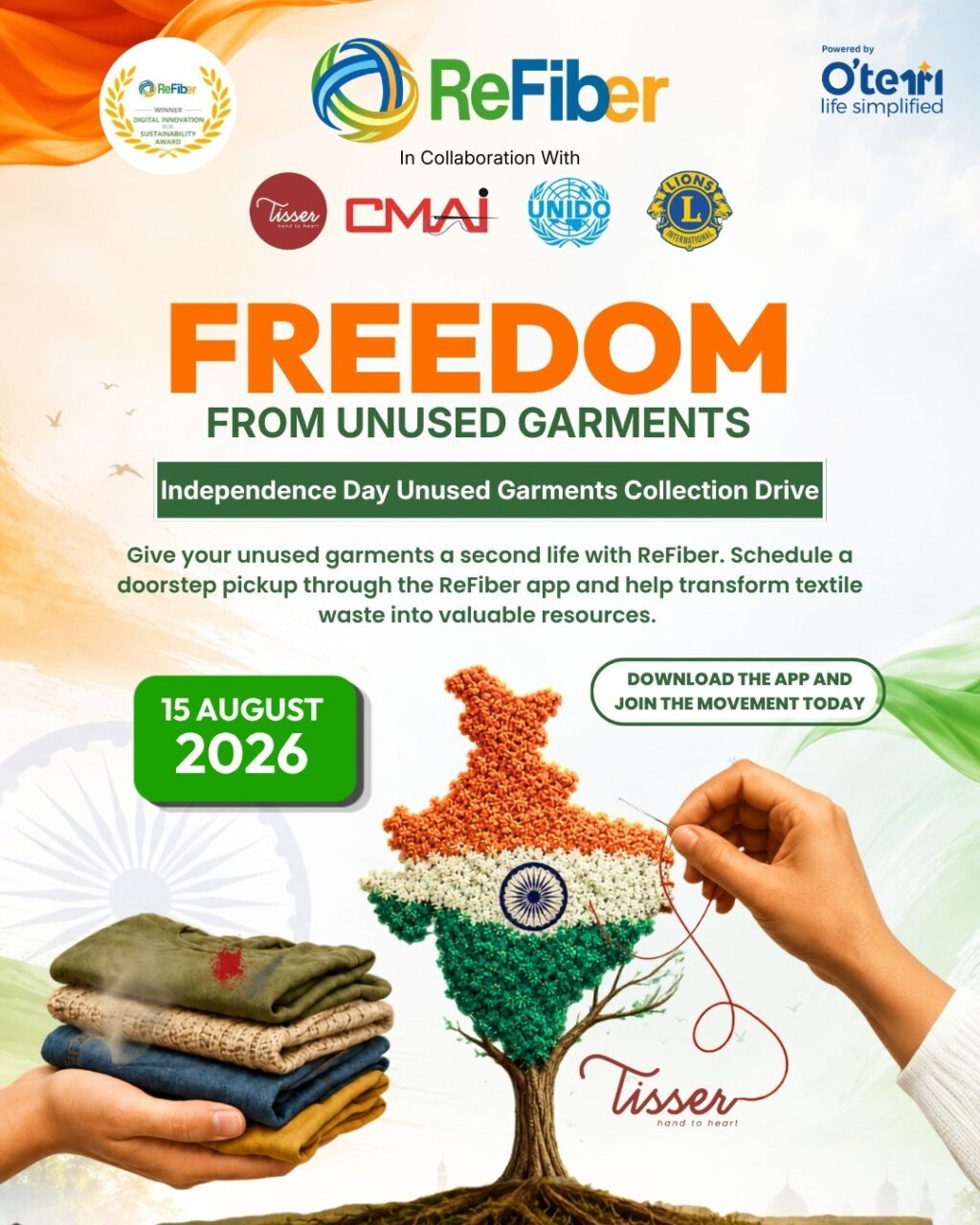
This Independence Day, a quiet revolution is unfolding in Mumbai’s laundry rooms and wardrobes — one that asks a simple but powerful question: what if the path to freedom begins with the clothes we no longer wear? On 15 August 2026, ReFiber, powered by OterRi, is launching ‘Freedom from Unused Garments’, a city-wide collection drive that transforms textile waste from a mounting environmental concern into a tangible resource for a circular future.
The initiative invites Mumbaikars to schedule a doorstep pickup of their unused garments through the ReFiber app, directing collected textiles toward reuse, recycling, and further processing. It is a call to extend the lifecycle of what we already own while reimagining what responsible consumption looks like in one of India’s most fashion-forward cities. The campaign arrives with the backing of an influential coalition — Tisser, the Clothing Manufacturers Association of India (CMAI), the United Nations Industrial Development Organization (UNIDO), and Lions International — uniting industry leaders, sustainability advocates, and community stakeholders under one shared mission.
The roots of this movement trace back to World Environment Day 2026, when ReFiber conducted its Mumbai Textile Circular Economy Demonstration Project. The results were telling: 2.7 tonnes of post-consumer textiles were collected through 275 collection orders from 257 citizens, facilitated by 15 laundry partners across 28 branches. Rather than building parallel logistics infrastructure from scratch, the project proved that Mumbai’s existing service networks — neighbourhood laundries already embedded in the fabric of daily life — could serve as powerful first-mile collection points for organised textile recovery. It was a proof of concept that resonated far beyond the city limits.
Gracing the virtual launch as Chief Guest is Ms. Vrunda Desai, Textile Commissioner, Maharashtra Government, who has extended her support for the initiative’s focus on citizen participation and awareness around responsible textile management. Her presence underscores a growing recognition that circularity is not merely an industrial process but a civic behaviour that begins at home — in the cupboards where unworn garments gather dust and in the choices we make about their next chapter.
“The success of the Mumbai demonstration has given us important insights into how textile waste collection can be made more organised, accessible, and scalable,” said Mr. Shrikant Bhangdiya, Chairman of the ReFiber Initiative. “The response from citizens and our network partners has shown that there is a clear opportunity to build greater participation around responsible textile management. Our aim is to take these learnings forward and work towards a model that can be replicated across cities — eventually supporting a nationwide movement for textile circularity. ‘Freedom from Unused Garments’ is an important step towards that larger vision.”
The ambition is unmistakably national, yet the mechanics remain rooted in local accessibility. By leveraging technology and existing urban service networks, ReFiber is attempting to bridge the gap between individual intent and systemic action — making it easier for citizens to do the right thing without upending their routines.
“Textile circularity requires collective participation from citizens, industry, government, and sustainability partners,” noted Mr. Manoj Wanvari, COO of OterRi & ReFiber. “Our Mumbai project demonstrated how technology and existing service networks can enable an organised first-mile collection ecosystem. Through this campaign, we aim to make responsible garment collection more accessible and strengthen pathways for reuse and recycling — with the learnings eventually contributing to a model that can be replicated across cities.”
As India marks another year of independence, the campaign offers a timely reminder that sustainability is not an abstract ideal but a series of deliberate, everyday choices. The garments hanging untouched in Mumbai’s closets represent more than forgotten fashion trends; they are untapped resources in a country where textile waste is both a challenge and an opportunity. By turning unused clothes into raw material for reuse and recycling, ReFiber is not just cleaning out wardrobes — it is laying the groundwork for a more organised, collaborative, and scalable textile collection ecosystem.
This 15th August, the call is clear: freedom from clutter, freedom from waste, and freedom to reimagine what our garments can become. For Mumbai, and potentially for India, the journey from a single demonstration project to a nationwide circularity movement may well begin with one pickup at a time.